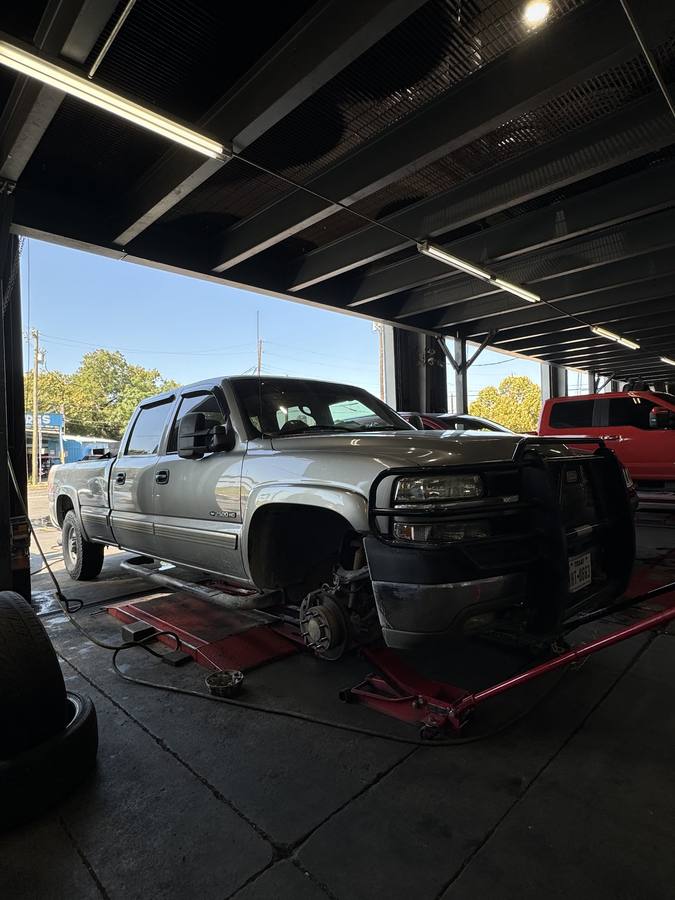
East DallasTPMS service
TPMS service in East Dallas
Quick answer
J & J Llantas Inc services tire pressure monitoring systems at 504 S Carroll Ave in East Dallas, TX. A TPMS warning light usually means a tire is genuinely low on air, so pressure is the first thing to check. Walk in any day between 7am and midnight, or call (214) 797-4292.
The light on the dashboard that looks like a flattened horseshoe with an exclamation mark in it is the one nobody wants to interpret in a parking lot at eleven at night. This page explains what that system is, what the light is actually telling you, and which parts of the answer a tire shop can deal with.
TPMS is not an optional extra
Federal Motor Vehicle Safety Standard No. 138 sets performance requirements for tire pressure monitoring systems so drivers are warned about significant under-inflation. It applies to passenger cars, multipurpose passenger vehicles, trucks and buses rated at 4,536 kilograms — 10,000 pounds — or less, other than vehicles with dual wheels on an axle. That is why almost every light vehicle on the road in Dallas has one.
What the light actually means
The standard requires the warning to come on when pressure in one or more tires falls to at least a quarter below the pressure the vehicle maker recommends, or to a floor value in the standard's own table, whichever is higher. In plain terms: the light is an under-inflation warning, and the first move is to check the pressures against the driver's door label, not to assume a part has failed.
Direct and indirect systems are different animals
A direct system has a battery-powered pressure sensor in each wheel, usually on the inside of the valve, reporting to a control unit in the vehicle. An indirect system has no sensors in the wheels at all: it infers under-inflation from wheel speed, because a softer tire turns slightly faster. Which one your vehicle uses changes what can be serviced and what cannot.
Why sensors have to be relearned
Direct sensors carry unique identification numbers, and those numbers have to be registered against their position on the vehicle with the monitoring module. That registration is what has to be redone when sensors are changed, when the module is changed, and in some cases when tires are rotated — which is why a sensor job is not finished the moment the new part is installed.
The system is a warning, not a maintenance plan
A TPMS tells you when something has already gone significantly wrong. It does not replace looking at your own tires. The U.S. Tire Manufacturers Association asks drivers to check pressure at least monthly, with the tires cold, against the figure on the driver's door label or in the owner's manual — the number moulded into the sidewall is a maximum, not a target.
Where the shop comes into it
TPMS service is one of the things J & J Llantas handles, at 504 S Carroll Ave, and it comes up most often alongside tire work, because the sensor is inside the wheel and the wheel is already open. What your particular vehicle needs depends on the vehicle, so bring it in or call (214) 797-4292 and describe how the light is behaving.
How pricing works
There is no number on this page because there is no single job behind the question. The outcome can be as simple as air in a tire, or it can involve the small service parts that go with a sensor while the tire is off the rim, or one sensor, or four. Vehicles differ in what sensors they take and in what has to be done to register them afterwards, and that difference is real work rather than a line item this site can predict. The way to find out is to have the vehicle looked at: walk in, or call the shop and say what the light is doing.
Call (214) 797-4292Common questions
Questions before you stop by
It means at least one tire has lost a significant amount of air — the federal standard sets the trigger at roughly a quarter below the pressure your vehicle maker recommends. Check the pressures against the label in the driver's door opening before assuming anything has broken. If the light stays on once pressures are correct, the system itself needs looking at.
Yes, within a defined range. Federal Motor Vehicle Safety Standard No. 138 applies to passenger cars, multipurpose passenger vehicles, trucks and buses with a gross vehicle weight rating of 10,000 pounds or less, excluding vehicles with dual wheels on an axle. That covers essentially every ordinary car, pickup and van you would drive to a tire shop.
Tires can be well below their proper pressure and still look normal, which is precisely why the system exists. Put a gauge on all four, cold, and compare the readings with the label in the driver's door opening. If the pressures are right and the light will not clear, bring the vehicle to 504 S Carroll Ave and have the system looked at.
Often it does, once the pressures are back where the vehicle wants them, though some vehicles need a short drive before the light clears. If the light comes back after a day or two, the tire is probably losing air slowly and the leak is the real problem. Call (214) 797-4292 and describe how quickly it returns.
Direct sensors are sealed, self-contained, battery-powered units that sit inside the wheel, so the battery is not a separate serviceable part the way a key fob battery is. When the power in one is gone, the part is replaced rather than opened up. Ask at the counter what your vehicle uses before assuming which case you are in.
Not as a rule. Vehicles differ, sensors fail one at a time, and the sensible answer depends on the age and condition of the others. What is true everywhere is that a direct sensor's identification number has to be registered to its wheel position afterwards. Bring the vehicle to 504 S Carroll Ave and ask what yours needs.
Because the monitoring module identifies each sensor by a unique number tied to a wheel position. Fit a new sensor and the module does not know it yet. That registration step has to be done when sensors are replaced, when the module changes, and on some vehicles after a rotation, which is why the job is more than screwing in a part.
It is a warning that a tire is significantly under-inflated, which affects how the vehicle handles and how the tire wears and heats. Ignoring it means driving without knowing which tire is low or why. Check the pressures cold against the door label, and if the light persists, bring the vehicle in rather than living with it.
It is the natural moment to raise it. The sensor sits inside the wheel and is only genuinely accessible while the tire is off the rim, so anything to do with it is easier during tire work than as a separate visit later. Mention it when you arrive at 504 S Carroll Ave rather than after the wheels are back on.
No. J & J Llantas Inc takes walk-ins seven days a week between 7am and midnight, and TPMS work is handled the same way as the rest of the shop's services. Drive to 504 S Carroll Ave in East Dallas during opening hours, or call (214) 797-4292 first to describe what the dashboard is showing.
Need tires tonight?
We are open until midnight.
504 S Carroll Ave, Dallas, TX 75223 · Open 7am to midnight, seven days a week · No appointment required